
Istanbul: A City Unchanged by Time
Updated: Jul 24
14 November 2025
بسم الله الرحمن الرحيم
We move through time in a world of endless thoughts — and endless access. Travel, once a distant dream, has become a convenience. The world feels smaller now, almost too reachable. With a few taps on a screen and enough funds in our pockets, we can chase our dreams, crossing continents before our coffee cools. It is both a blessing and a quiet curse.
When I boarded a short five-hour flight from Sharjah to Istanbul last week, I thought I knew what awaited me. I had read about the Ottoman Empire in history books, seen its grandeur framed in documentaries and photographs. My imagination painted scenes of sultans and scholars, of domes and courtyards bathed in soft morning light, of the call to prayer floating over the Bosphorus like an aria. Yet when I arrived, the city felt different — larger than the stories, yet quieter than the legends.
There was a strange duality in my first steps through Istanbul: a mixture of awe and a subtle underwhelm. Perhaps it was the weight of expectation, or the saturation of images I had already consumed. In this age of infinite scrolling, we visit places long before we arrive — digitally, imaginatively — and by the time we stand there in truth, the wonder has already been half spent. That is the curse of easy travel: arrival without anticipation.
And yet, the blessing remains — the ability to go, to stand where history once breathed and to let a city speak for itself. In Istanbul, that dialogue between past and present is unbroken. Minarets loom over the city; ferries hum beneath bridges that link continents; the adhan echoes over the noise of trams and traffic. The city is a living metaphor for coexistence — East and West, modernity and tradition, empire and republic.
I wandered through the streets without a rigid plan — no companions, no checklists. Instead, I allowed myself to move slowly, to observe. Whether in a crowded restaurant or a quiet residential lane, there was a calm stoicism in the air — an unspoken patience that defined both the people and the place. It was as if the city had learned to carry its centuries without complaint.
Galataport gleamed - modern and polished for visitors, but a few turns away, the stones of Old Istanbul whispered of another age. Here, architecture became worship — every mosque a verse of praise rendered in stone and geometry. Their domes created the skyline, their interiors adorned with arabesques and verses of the Qur’an that attest to symmetry, order and the perfection of divine design. The engineering and artistry was not vanity but devotion — a pursuit of beauty that mirrored the perfection of Allah swt’s creation.
:::
This time, my journey was anchored in the 18th Istanbul Biennial, which opened its first leg in September 2025 under the curation of Christine Tohmé. In a bold departure from tradition, the Biennial unfolds across three years — an evolving experiment in time, art and meaning. Around the upmarket Galata neighbourhood, the theme "The Three-Legged Cat" explored the fragile rhythm of existence: our constant balancing act between creation and collapse, care and chaos.
Within the constellation of works from the Biennial and at art spaces in Istanbul, seven pieces lingered with me long after I left the exhibition halls — each a quiet mirror of the pain and perseverance woven into our shared human story.

At Istanbul Modern, Ferhat Özgür’s I Can Sing (2008) unfolded like a prayer interrupted. In a barren patch of Ankara’s urban sprawl, a woman in traditional clothing lifts her arms as though in supplication — yet her voice is replaced by a man’s singing Hallelujah. The contrast pierced me: a requiem for the middle ground between faith and modernisation, between what we remember and what we are losing.

Nearby, Gülsün Karamustafa’s NEWORIENTATION (1995) transformed a room into a hanging graveyard of memory, in tribute of the women working in the Galata brothel during Genoese times. Sailor's ropes descend from the ceiling, each adorned with pink ribbons bearing the names of women who went missing in Istanbul in the early 1990s. Their fates tied, literally, to the profit and pleasure of others. It was impossible to stand there and not think of how pain multiplies in silence — how when one woman suffers, all of her community should grieve. When there is pain, healing must follow.

From the Amazon, Ana Alenso’s What the Mine Gives, the Mine Takes (2020) spoke of another kind of wound — the devastation of land and communities through extraction. Her machine-like installations of scrap metal, exhaust pipes and found materials resembled both an altar and a warning, a monument to the greed that poisons the earth. The greed that comes from our very own people; our descendants and those who chose not to participate paying the price for protecting nature.
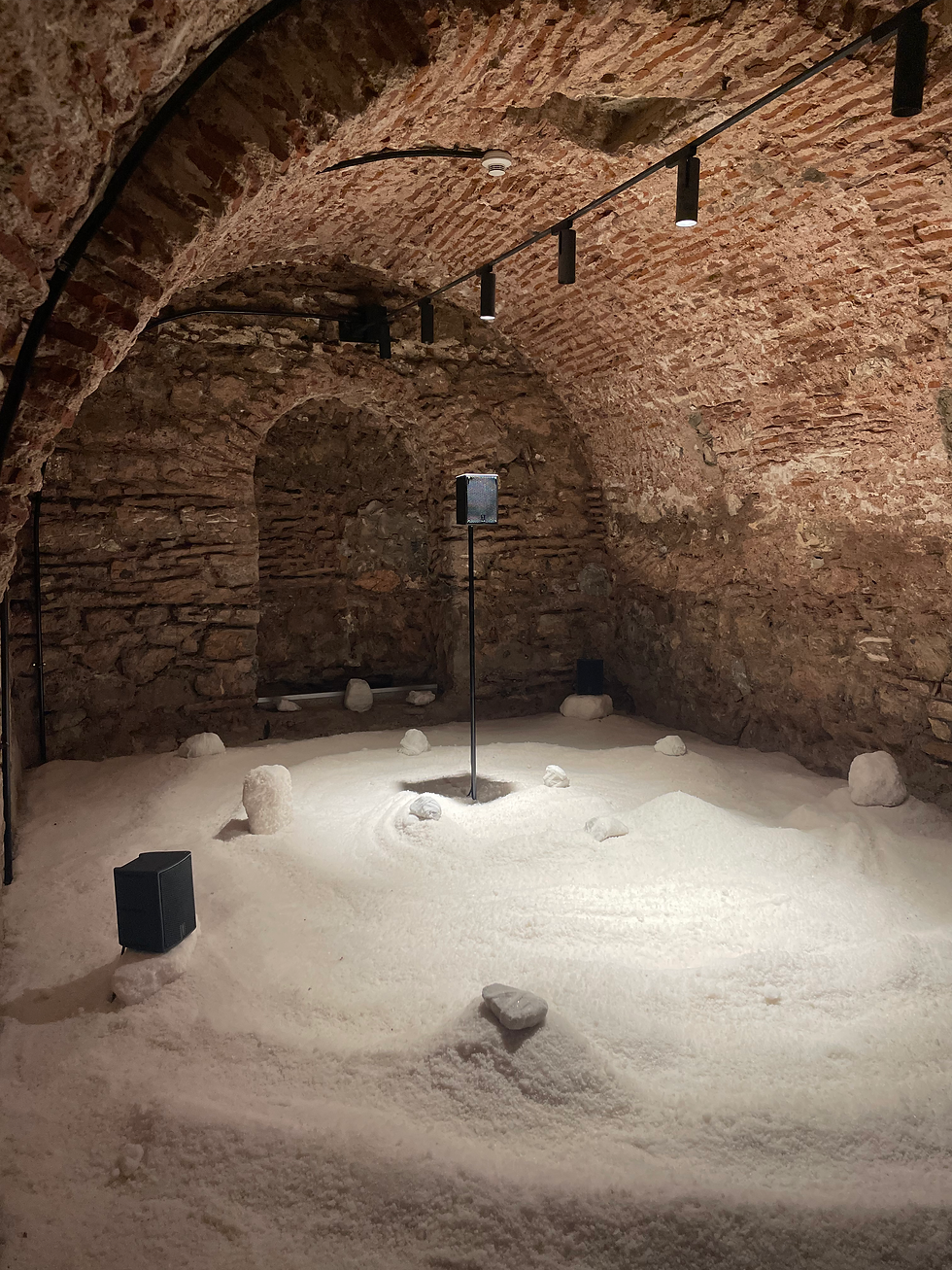
In Ayman Zedani’s Between Desert Seas (2021), mounds of sea salt formed tomb-like landscapes while whispers of endangered humpback whales in the Arabian Sea and Prophet Yunus’ journey in a whale's belly resonated through nine audio channels. The installation bridged history and ecology — salt as both preservation and decay through desalination technologies, echoing how modern industry reshapes the seas. We are once again reminded of our fragile stewardship of this planet, and how easily we forget.

Ola Hassanain’s A Whispering Dam (2024) brought me to Sudan’s Blue Nile, where a man-made dam and a grandmother’s crumbling home have become symbols of endurance. The work, accompanied by a softly chanted ruqya (قية), a protective incantation, whispered resilience - of caretakers who watch over the Earth’s waters and over the ruins of memory. These quiet watchers are the guardians we often overlook, yet they hold together the world’s fragile balance.

In Doruntina Kastrati’s A Horn That Swallows Songs (2005), I stepped into a factory simulation filled with the echo of women’s unseen labour — the repetition, exhaustion, and invisibility of those who sustain industries and families yet remain unnamed - as if machines themselves. Perhaps a reference to us as bystanders — the suffering we see on our screens, to the quiet heroism we pass by daily without notice.

And finally, Sohail Salem’s work from Gaza - Distress Call (2024) - stood as both wound and testimony. As we watch a genocide unfold daily before our eyes, any image, sound, or story that emerges intact from Gaza becomes a sacred archive — a fragment of truth against the silence of the world. Hovering over a creased piece of paper, much like a bystander looking through a screen, I felt a heaviness that words cannot ease. It was a reminder that faith, art and humanity all demand the same thing of us: to feel each other’s pain as our own.
:::
These seven works became my quiet teachers. They spoke not only of global crises but of the inner work required to respond — to care, to heal, to repair. They reminded me that beauty and suffering are not opposites, but part of the same truth: that everything fragile in this world is worth protecting.
As I left Istanbul, I understood something simple yet profound. The truest form of travel is not in the miles we cross, but in how far our hearts are willing to reach — to see creation in all its forms, to honour the wounds of others as if they were our own, and to remember that beneath our differences, we remain one family under the same sky.


Comments