
Prayer: The Backbone of Islam
Updated: Jul 24
26 June 2025
بسم الله الرحمن الرحيم
Today marks the last day of Dhul Hijjah (ذُو ٱلْحِجَّة), one of the four sacred months in the Islamic Hijri calendar - and the month in which Muslims from all around the world (25% of the global population) congregate in Makkah, Saudi Arabia to perform the pilgrimage of Hajj, where rites are performed over 5 to 6 days. Hajj is the fifth of the five pillars of Islam, and is obligatory for every adult Muslim who is financially and physically able. In the modern world, Hajj has been recognised as the greatest gathering of humankind, with 1.67 million pilgrims from 171 countries being called to Hajj this year. Above all, Hajj is not just a journey, tradition, ritual or congregation. It is a quest of great spiritual significance - one of intention, equality, submission, understanding and renewal.
The world “Islam (إسلام)” is an Arabic term which translates to “submission” or “surrender”, derived from the root Arabic letter trio “(س-ل-م) S-L-M” - a concept that encompasses the attainment of peace and security through submission to Allah*. The terms “Muslim (مُسْلِم)”, a follower of Islam, and “Salam (سلام)”, the greeting between Muslims, also derive from the same root.
* Allah (الله) is an Arabic term used to refer to the one divine Creator; derived from the term Al-ilah (الاله) - “the God”. Linguistically from the same family as other Semitic languages such as Aramaic (ܐܲܠܵܗܵܐ ʼAlaha) and Hebrew (אֱלוֹהַּ Eloah); also used by Jews and Arab Christians to describing the same deity
The Qur’an (ٱلْقُرْآن) (“recitation”) is the religious text of Islam - a direct oral revelation in Arabic from Allah to the Prophet Muhammad through Archangel Gabriel over a period of 23 years. Recorded in writing, divided into 114 Surahs (chapters) by Prophet Muhammad’s earliest followers, the Qur’an has not been changed since its compilation.
˹He is the˺ Lord of the heavens, and the earth, and everything in between. So worship Him ˹alone˺, and be steadfast in His worship. Do you know of anyone equal to Him ˹in His attributes˺?” (Maryam 19:65)
:::
In April, I was fortunate to make my second trip to Jeddah on the occasion of the 2025 Islamic Arts Biennale - in its second iteration organised by the Diriyah Biennale Foundation (a nonprofit under the Kingdom’s Ministry of Culture, part of Vision 2030). The biennale’s title “And All That Is In Between” (وما بينهما) is taken after a phrase that appears in the Qur’an at least fifteen times: “And God created the Heavens and the Earth and all that is in between”, alluding to the vast capability of our divine Creator as well as expansive, interconnected radius of the universe as experienced by humankind - physically, metaphorically and spiritually.
By the grace and benevolence of God, the Heavens and the Earth were created, and everything in between - the universe, its atmosphere, the monumental mountains, our endless seas and eternal skies, every drop of rain, each breath of air that we inhale, the first cell in our body extracted from a quintessence of clay.
Creation is an act of God.
Everything that we see, hear, taste, smell, feel and touch points to a divine Creator. The incredible metamorphosis of a caterpillar into a butterfly is just one of limitless phenomena that we are fortunate to witness on Earth. The very nature of mortality and the transience of time reveals an almighty and eternal Creator, with life as a finite passageway through one’s journey to the Hereafter.
Indeed your Lord is Allah Who created the heavens and the earth in six Days, then established Himself on the Throne. He makes the day and night overlap in rapid succession. He created the sun, the moon, and the stars—all subjected by His command. The creation and the command belong to Him ˹alone˺. Blessed is Allah—Lord of all worlds! (Al-A'raf 7:54)
Exploring Faith Through Feeling, Thinking and Making.
Through God’s love and mercy, humans were created with free will - the capacity to choose between good and bad, right and wrong; the ability to reject His goodness and kindness; the freedom to be evil and to harm others; the inclination to feel and to think; the aptitude to create and to give; the heart to love, to hurt, to be grateful and to forgive.
Our memories are rooted in places real and remembered. At times, we experience nostalgia and a sense of longing - a desire for someone or something that no longer exists. During periods of loss and grief, our stored memory recollects the happiest moments that replay over and over in our heads. We often think of our identities as linked to an unchanged past, familiar places and faces, habitual patterns and customary traditions, but we forget that from birth, we were granted the freedom and fluidity to change and grow as we move through time and different spaces.
Dunya (دُنْيَا) (life on Earth) is a transient phase, referring to our limited, predetermined time on Earth - a temporary abode and a test for our eternal life in Akhirah (الآخرة) (Hereafter), as evident by the nature of death when our organs stop functioning, our body begins decomposing and our sustenance of life - our soul - returns to the Creator. At this stage, we embark on our path in Akhirah to get to the ultimate goal, Jannah (جنة) (Heaven). This is why every practising Muslim strives for Ihsan (إحسان) (excellence) and Adab (أدب) (ethics) in their Deen (دِين) (way of life), knowing that Dunya and Akhirah are connected. The choices, actions, thoughts and deeds we make in Dunya will determine our fate in Akhirah.
Say, ˹O Prophet,˺ “My Lord has commanded uprightness and dedication ˹to Him alone˺ in worship, calling upon Him with sincere devotion. Just as He first brought you into being, you will be brought to life again.” (Al-A’raf, 7:29)
By virtue of giving humans the gift of life in Dunya, the Qur’an encourages us to constantly contemplate the universe and reflect upon the immensity of the space around us. Through daily practice of Islamic values, we cultivate our inner sensibility, learning to feel and to transform the ordinary into the numinous. Indeed, Allah has already designated sacred borders of intangibility such as Ihram (إِحْرَام), a frame of mind and an intention to be made before entering the pilgrimage boundary.
:::

In the context of the Islamic Arts Biennale, from the moment we arrive at Jeddah’s open-air Western Hajj Terminal - situated in a separate plot of land beside the city’s main airport - we traverse through a hallowed space and a recollection of time; a poignant memory of a once-spiritual arena that marked the beginning of pilgrims’ journey to Makkah. Today, this reimagined complex is home to a cultural space, accessible to the public - its conical fiberglass fabric roof structure celebrated for its visual aesthetic that resemble nomadic dwellings and those of the Mina Valley, with few knowing that the compound was considered a feat of structural and mechanical engineering at its time of completion in 1981. The tent-like canopies reflect 76% of the sun’s radiation, maintaining a constant internal temperature of 80°F (27°C), when external temperatures reach 130°F (54°C).

Through the extraordinary gathering of 500 historical and contemporary objects from the Islamic world - sourced from inside the Kingdom as well as 30 institutions across 20 countries - we witness a remarkable continuing history of the Islamic civilisation that transcends time, borders, culture and society and which, much like Hajj, reflects the diversity, universality, kinship and richness of Islam.
Interweaving dialogues between the tangible and the transcendent, the first hall Al Bidaya (البداية) (The Beginning) holds a collection of artefacts from the holy cities of Makkah and Madinah, including relics that have never been displayed outside the two cities (note: non-Muslims are not permitted to enter Makkah). Walking through a narrow passageway from a hall displaying a rare uncut Kiswah (black silk cloth that covers the holy Ka’bah in Makkah), we stand before Libyan artist Nour Jaouda’s installation “Before the Last Sky”.

“What makes space sacred?” Jaouda asks herself, as she shuttles between Cairo and London - her practice embodied in ideas of rootlessness and regeneration; her identity continuously being shaped and formed in a constant process of becoming.
Believers and non-believers alike, we often turn to prayer in our darkest moments. We humble ourselves. We allow ourselves to be vulnerable. We submit and speak to an unseen force greater than nature; an entity we intuitively look for. As we weep silently, Allah heals our hearts. By way of this, we accept that there is a divine being and that nothing in life is in our control. In Islam, prayer (Salah) is an act of submission - the only direct channel between the mortal and the divine; a link between the Heavens and the Earth; a private space to let go and be our most naked selves. Each prayer is a chance for us to repent, to seek forgiveness, to ask for favours, to praise our Creator for everything around us, to live with intention and sincerity, and to entrust all aspects of life to God’s will. Where there is no prayer, there can be no purification of the soul. What our heart is to our body, prayer is to religion - prayer is the language of the heart.
And seek help through patience and prayer. Indeed, it is a burden except for the humble— (Al-Ankabut 2:45)
Salah (ٱلصَّلَاةُ) (“making a connection”) constitutes the second of the five pillars of Islam. For a Muslim, Salah is the most important manifestation of Islam. Through the common prayer, Islam imparts a sense of unity that transcends race, ethnicity, class, nationality, language and socio-economic status. As Muslims, we use the term Ummah (أُمَّة) to describe our collective community of brothers and sisters. The concept of Ukhuwwah (أخوة) (brotherhood and sisterhood) is a fundamental tenet of Islam, and a constant reminder of the bonds of unity and responsibility that tie the Muslim Ummah together. Around the world, we stand in solidarity with each other, responding to the struggles of our brothers and sisters - grieving with them, caring for them and standing up for their dignity. This is not simply advocacy or sentimentalism, it is done with consciousness and sincerity for the love of humanity, through Allah’s message in the Qur’an.
The believers are but one brotherhood, so make peace between your brothers. And be mindful of Allah so you may be shown mercy. (Al-Hujurat 49:10)
By praying the obligatory Salah five times a day, Muslims nurture their worship with Allah through submitting to Him to create an intimate bond that cannot be replicated by any other relationship in the world. The very act of Salah is a constant reminder of God’s presence, His guidance, and the need for repentance and gratitude. Unlike meditation or other spiritual practices, Islamic prayer is a conscious and intentional act. Throughout the common prayer in words, memory, movement and intention (ritual explained below), Muslims seek Allah’s mercy with humility, fear and obedience - understanding that we are merely His servants. Its precise body movements, which are performed in tandem with memorised passages from the Qur’an, purifies the mind, body and soul - regarding the soul as an organ of the body that yearns for freedom. The essence of our spiritual experience during Salah is Khushu (خُشُوع) - a state of deep humility, reverence, stillness of the body and concentration in the heart. Not merely a physical ritual or recitation of passages in Arabic, Khushu forms the soul of our prayer. Without our soul, the body is lifeless. Without Khushu, Salah lacks spiritual depth and inner richness. It is therefore only through this sole act of Salah combined with Khushu that we are able to find inner peace and freedom within us.
“Truly in the heart there is a certain loneliness that cannot be removed except by spending time with Him in solitude. In it there is a sadness that cannot be removed except through the happiness of knowing Him and being true to Him… In it there is a void that cannot be filled except through loving Him, turning to Him constantly, always remembering Him, and being sincere to Him. Were a person to be given the entire world and everything in it, it would never fill this void.”
- Ibn al-Qayyim (rahimahullah)
:::
Muslims pray anywhere and everywhere. In airports for travellers, on the streets for construction workers who do not have easy access to a private space, in dressing rooms for malls without dedicated prayer rooms, in empty classrooms or meeting rooms when there is no mosque in the vicinity. In no other religion is prayer taken as seriously as Islam. Iman (إِيمَان) (faith) is the nucleus of all Muslims, with Salah as the anchor for time, rhythm and purpose - its surrounding space taking up a transitory and malleable role. In this context, a prayer mat transforms from mundane to sacred - moving from place to place, inhabiting new spaces and creating temporary holy abodes that are calming, meditative and reflective.
When you bring your body to the ground
After days or running
And you lay your head there to rest;
When you utter subhana rabbi al a’la,
Glory be to Allah, my Lord, the Most High,
Ever so softly
So only you and your Rabb can hear;
It is Allah;
Welcoming you home,
Embracing you,
For you had not come home in a while.
It is Allah,
Speaking to you,
Reminding you,
‘And He found you lost and guided you’
So will you not be grateful?
It is Allah,
Comforting you,
Reminding you,
‘Do not be sad, indeed Allah is with us’
So will you not be hopeful?
It is Allah,
Healing you,
Reminding you,
‘Verily with hardship there is ease’
So will you not be patient?
When you pour your heart out in sujood,
And you tell your Lord,
Of your aching limbs;
Of your crying heart;
Of you tired soul;
He will tell you:
‘Come home, you will be healed.’
‘Come home, you will be loved.’
‘Come home, you will be nourished.’
And you will wonder why you ever left in the first place.”
(Source: Instagram. Origin: Unknown)
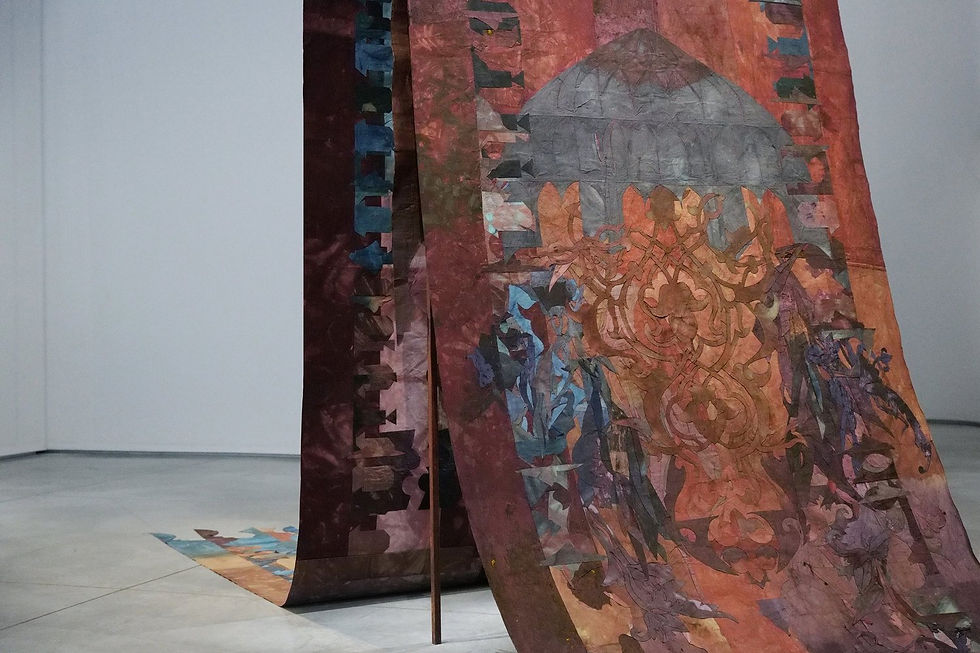
Before The Last Sky is a textile triptych about the ritual of prayer and significance of the prayer mat. Just like our time on Dunya, the prayer mat is presented as an object of impermanence, acting as a threshold between the material and the spiritual. Oriented towards Makkah, over 30 metres of richly textured large-scale tapestries suspend from the ceiling and cascade towards the floor, symbolising three expanded prayer mats representing the three primary postures in Salah: Ruku (رُكوع) (bowing), Sujud (سجود) (prostration), and Julus (جلوس) (sitting). Jaouda sourced patterns from old prayer mats found in mosques and her family homes, deconstructing and re-assembling them with a defined composition, bringing new life and meaning into a forgotten past. Through the process of fabric cutting, hand-dying, drying, ironing, recutting and replacing, the ebb and flow of creation is relished, with physical motions deeply embedded in its slow and labour-intensive making. Textiles have no beginning or end. Like prayer mats, they are everything in-between: a form of remembrance - of a person, place or object that it once hosted. The final work is an amalgamation of dense and fragile fibres, revealing an intricate layering and material deconstruction which are intimately linked to the traversal of countries, languages and cultures.
In Jaouda’s practice, colours in her work not only translate the atmosphere of her inner world, but also function as a language for emotion, materialising the energy of the city in which her practice occupies at that moment in time - from the chaos, vibrancy, noise and dust in Cairo to the softer, darker and muted hues in London. The work’s earthen hues comprise of a contrast of blues (symbolising the sky, the divine and the spiritual), a mix of reds and browns (reflecting the Earth, the ground and the mundane) and colours that are formed in between them. The natural and synthetic pigments alter the physicality of the textiles, taking on a new dimension and complexion that crease and intensify with time.

Securing the fabrics to the ceiling are elegant steel gates, inspired by the crenellations that surmount the walls of mosques, reflecting on the porous borders that connect the Earth and the Heavens. Gates are not simply functional, but also serve as architectural forms. Similar to doors and windows that inhabit space but do not interrupt it, gates occupy the in-between. In Before The Last Sky, gates undertake the role of a passageway to the sky, much like the eight gates of Jannah. In juxtaposition with the delicate nature of Jaouda’s textile pieces, the medium of steel reminds us of the strength and resilience needed to get to Akhirah. Weaving together textiles, architecture and memory, Before The Last Sky embodies the realm of the in-between and its infinite possibilities - a testament to the migratory and nomadic nature of a solitary prayer mat.
He is the˺ Lord of the heavens and the earth and everything in between—the Almighty, Most Forgiving.” (Sad 38:66)
:::
Through Salah, Islam constantly reminds us of death. Two key tenets in Islamic theology are Akhirah (الآخرة) and the Day of Judgement (یوم القيامة). Akhirah refers to eternal life after death, the final destination for Muslims and also the place of reward and punishment. The Day of Judgement marks the end of the world and the beginning of Akhirah. On this day, all humans will be resurrected and judged by Allah based on their actions in the Dunya, with the righteous gaining entry to Jannah (Heaven) and the sinful facing punishment in Jahannam (جهنم) (Hellfire).
Since death is essentially the separation of our soul (spirit) from the body (physical) and the world, in Akhirah, we will be judged only by our spiritual commitment, sincerity, intention and adherence to Islamic principles. This belief forms the basis of Islam.
Every soul will taste death. Then to Us will you be returned. And those who have believed and done righteous deeds - We will surely assign to them of Paradise [elevated] chambers beneath which rivers flow, wherein they abide eternally. Excellent is the reward of the [righteous] workers. (Al-Ankabut 29:57-58)
The Islamic lifestyle is designed around intentionality. Salah is a marker for time and purpose, connected to definite times of the day and a fixed geographical direction. This creates a natural rhythm in one’s life, bound to nature and its movements - a constant reminder of the irreversible progression of time, and at the same time, equipping us with the discipline to focus, manage time and grow spiritually.
Universally, performing Salah is a process with a structure and a set of conditions which must be followed. Comprising a number of raka'at (رَكْعَة) - a single unit of prescribed active physical movements and recitations, each movement in Salah symbolises humility, submission and reverence towards Allah.
The five prayers and their number of raka’at are:
Fajr (2 raka’at): Between the break of dawn and sunrise
Zuhr (4 raka’at): Midday
Asr (4 raka’at): Between Zuhr and sunset; the most important as the middle prayer
Maghrib (3 raka’at): Just after sunset
Isha (4 raka’at): When twilight has disappeared until midnight (preferably) or Fajr
A sacred act, performing Salah requires a mandatory dress code, which ensures certain areas of our bodies remain covered, as well as the ritual of Wudu (وضوء) (cleansing). Without proper clothing and Wudu, Salah is invalid. The objective of Wudu is utilising flowing water to physically remove dirt from various parts of our skin, as well as purification of the soul through Niyyah (نِيَّة) (making an intention in your heart to perform an act for the sake of Allah).
As the Adhan (أَذَان) (call to prayer; “listen”) is recited and broadcasted from the minaret of a mosque, we are called to our appointment with Allah. The Adhan cuts through the chaos of life - it is a reminder to your soul as to why we were sent into Dunya. The Shahada (الشَّهَادَةُ), the first pillar and foundation of the Islam, is also recited several times in the Adhan - reaffirming our faith.
Allahu Akbar! (four times)
(God is Great!)
Ashhadu an la ilaha illa Allah. (twice)
(I bear witness that there is no god except the One God.)
Ashadu anna Muhammadan Rasulu-Allah. (Twice)
(I bear witness that Muhammad is the messenger of God.)
Hayya 'alas-Salah. (twice)
(Hurry to the prayer.)
Hayya 'alal-Falah. (twice)
(Hurry to salvation.)
Allahu Akbar! (twice)
(God is Great!)
La ilaha illa Allah.
(There is no god except the One God.)
:::
The Ka’bah (ٱلْكَعْبَة), a physical structure in Makkah, acts as the central point in Islam, with all Muslims facing towards the Qibla (قِبْلَة) (“direction”) during Salah. This united act, a command from Allah, emphasises the shared faith of Muslims and directs the minds of believers towards their Creator.
To begin Salah, Muslims adopt Qiyam (قيام), a standing posture with feet slightly apart, accompanied by a lowered gaze. This is the position in which humans will stand before Allah on the Day of Judgement. We raise both hands, palms facing out, to shoulder level, whilst saying the Takbir (تَكْبِير) (“greatness”) with conviction. The two words of the Takbir are Allahu Akbar (الله أَڪْبَر) (God is Great). Reciting the Takbir reiterates God’s greatness and our insignificance.
Salah has now been initiated and Muslims enter a state of Ihram (frame of mind). We fold our arms, the right grasping the left - a position conducive to attaining Khushu, and at the same time, preventing fidgeting. At this moment, reciting the Isti'adhah (اَلْإِسْتِعَاذَةُ) (seeking protection) is recommended, to reduce the distractions and influence of Shaytan (Devil) during Salah.
A'oodhu Billahi min al-Shaytaan ir-Rajeem.
(I seek refuge from Satan the Accursed)
When you recite the Quran, seek refuge with Allah from Satan, the accursed. He certainly has no authority over those who believe and put their trust in their Lord. (An-Nahl 16:98-99)
We proceed to recite Surah Al-Fatihah, the opening chapter and essence of the Qur’an.
Bismillaahir Rahmaanir Raheem
(In the name of Allah, Most Compassionate, Most Merciful)
Alhamdu lillaahi Rabbil 'aalameen
(Praise be to Allah, the Lord of all worlds)
Ar-Rahmaanir-Raheem
(Most Compassionate, Most Merciful)
Maaliki Yawmid-Deen
(Master of the Day of Judgment)
Iyyaaka na'budu wa lyyaaka nasta'een
(You alone we worship and You alone we seek help)
Ihdinas-Siraatal-Mustaqeem
(Guide us along the straight path)
Siraatal-lazeena an'amta 'alaihim ghayril-maghdoobi 'alaihim wa lad-daaalleen
(The Path of those You have blessed—not those You are displeased with, or those who are astray)
Ameen
(O Allah, respond)
After completing the recitation of Surah Al-Fatihah, we raise our hands and repeat Allahu Akbar before going into Ruku (رُكوع), a bowing posture. This pillar of Salah is one of the most significant, in terms of physical movement and recitation. When we lower our heads and straighten our backs, we surrender to Allah’s command like servants, humbling our heart, tongue and limbs in His service.
Subhana Rabbiya l-ʿAzim (three times)
(Glory be to my Lord, the Most Magnificent)
After praising Allah, we return to an upright position with hands raised, saying:
Sami Allahu liman hamidah
(Allah hears the one who praises Him)
We drop our hands by our sides and respond with:
Rabbana wa lakal-hamd
(Our Lord, and to You be the praise)
This short standing position after Ruku allows a brief moment of reflection before the greatest pillar of Salah, Sujud (سُجُود) (prostration).
Again, we raise our hands and say Allahu Akbar before descending into Sujud.
Sujud is perhaps the most quintessential posture of Salah. Every ritual and movement that preceded Sujud was made in preparation for it. Sujud is an active full body kneeling position, whereby both palms, both knees, both big toes, your forehead and your nose touch the ground. It is an inherently humbling position to put yourself in, signifying our complete submission to Allah - drawing us close to His mercy and reminding us of how close He is. Sujud also stresses our ultimate place of return - the grave. We lower our face, heart and ego to the ground - onto the same earth that people walk upon, and the same substance that we were created from.
We have sent down the Quran in truth, and with the truth it has come down. We have sent you ˹O Prophet˺ only as a deliverer of good news and a warner. ˹It is˺ a Quran We have revealed in stages so that you may recite it to people at a deliberate pace. And We have sent it down in successive revelations. Say, ˹O Prophet,˺ “Believe in this ˹Quran˺, or do not. Indeed, when it is recited to those who were gifted with knowledge1 before it ˹was revealed˺, they fall upon their faces in prostration, and say, ‘Glory be to our Lord! Surely the promise of our Lord has been fulfilled.’ And they fall down upon their faces weeping, and it increases them in humility.” (Al-Isra 17:105-109)
In Sujud, we recite the following phrase three times:
Subhana Rabbiyal A'la
(Glory be to my Lord, the Most High)
Allahu Akbar is repeated whilst transitioning from Sujud into a sitting posture called Julus (جلوس), asking for forgiveness three times:
Rabbighfirl
(My Lord, forgive me)
We declare Allahu Akbar for the last time whilst returning to Sujud, followed by the following phrase three times:
Subhana Rabbiyal A'la
(Glory be to my Lord, the Most High)
After the main component of Salah is completed, we move back into Julus and recite the Tashahhud (which includes the Shahada), with our index finger on the right hand pointing straight ahead when reciting the Shahada - affirming the oneness of God, reiterating His glory and sending greetings to the Prophet Muhammad.
Attahiyyaatu lillaahi wassalawaatu wattayyibaatu
(All greetings, prayers and pure words are for Allah)
Assalaamu 'alayka 'ayyuhan-Nabiyyu wa rahmatullaahi wa barakaatuh
(Peace be upon you, O Prophet, and the mercy of Allah and His blessings)
Assalaamu 'alaynaa wa 'alaa 'ibaadillaahis-saaliheen
(Peace be upon us and upon the righteous servants of Allah)
Ash-hadu 'an laa 'ilaaha 'illallaahu
(I bear witness that there is none worthy of worship but Allah)
wa 'ash-hadu 'anna Muhammadan 'abduhu wa Rasooluhu
(and I bear witness that Muhammad is His servant and His Messenger)
Following the completion of Salah, we conclude with a salutation - turning our heads to the right side followed by the left, sending greetings to the angels and fellow congregants surrounding us:
Assalamu alaikum wa rahmatullah
(May the peace, mercy, and blessings of Allah be with you)
:::
As we exit Dhul Hijjah and enter the new Hijri year 1447 AH with the first month of Muharram (ٱلْمُحَرَّم), we begin on a clean slate - renewing our faith and intentions with sincerity and commitment. In the Islamic calendar, time begins with migration. Guided by the Prophet Muhammad and his companions’ Hijrah (الهجرة) from Makkah to Madinah, for Muslims, this journey symbolised a new start, a transformation of human history and a movement from darkness to light.
One prayer. One du’a. One righteous deed. Each action leads us one step closer to Allah.
:::
References
AbdulWahid Hamid, Islam: The Natural Way, MELS, 1989 / 2004
H.R.H Prince Ghazi bin Muhammad, A Thinking Person’s Guide to Islam, White Thread Press / Turath Publishing, 2017 / 2023


Comments